
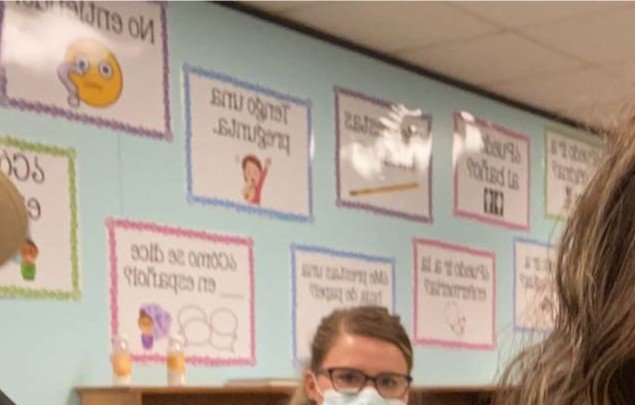
¿Qué Tal?
Who would think that a website named in Spanish would ever talk about Spanish in an innovation class? I didn’t, but life is interesting.
For sound, I had to go back to my high school era, not a pleasant time to look back on, but the mind wanders and finds treasures… sometimes. So I picked the Spanish Listening Exams that we had to do, over and over again, in preparation for the end-of-year exam. One thing that I acutely remembered was the horrible sound effects that they would place in the audio. So I decided that it would be a fun idea to replicate that, but to refine it a bit.

El Sendero
I did condense it a lot because I assume the class does not understand Spanish well, but the format is the same. You have instructions, a beep, and then the audio. I’m not gifted enough to make a convincing beeping sound with my voice, so I just found one online. I recorded 3 different “voices”: the first was the prompter (Standard American Accent), a younger man (Rioplatense Spanish), and an older man (Castilian Spanish). This was typical of the exams that we had, and a practical choice as doing different accents is easier for listeners to differentiate, as I am only one person.
The plot is so simple, if you can understand it, but the older man is writing an essay (hence the typing in the background), this was a sound that I made using my keyboard. Then Matias, the younger man, enters, greets the man, and asks him if he is well and why he is coughing. The cough was also mine, not a very dignified sound, but it works. Matias notes that the man needs something to drink, and he says that he wants a nice glass of milk, so Matias pours him some. This sound was one that I found online.
Tecnicismos
I worked with audio in the past, as I had a class where we had to edit and create videos. That was in middle school, so I didn’t remember much. Plus, the software that we were using was on MAC, and I had never heard about Audacity before, but I knew enough not to join the struggle bus this time.
To make my life easier and avoid having to splice the Spanish audio, I added natural pauses between the phases, knowing the sound effects would cover them. I also ensured that the audio used a relatively standard Spanish, so no overly difficult accents like those found in Andalusian Spanish or Caribbean Spanish. I spoke slowly, but not too slowly so as not to make the “test takers” feel like it was made for dummies. It took around 20 whole minutes to get the audio right and to place my phone at the right angle to get the best sound and no pops. These pops tend to happen when the speaker is speaking slightly above the mic, and it is very hard to fix on a soundboard. The best you can do is lower the low frequencies as much as possible (I find that this does not affect quality too much).
Unfortunately, I do not have a sound board, so what I make has to be good without gimmicks or little tricks. I can trepidatiously say that I did that, hopefully… Overall, it was nice to create this project; it brought some negative nostalgia from more miserable times.
Pa' Los Yanqui
What I am interested in seeing is how many people will understand what is going on in the exam part of the audio. My voice is clear, but I didn’t use that fake academic jargon that no one actually speaks with, yet if one knows Spanish (at least to the level we were expected to for the test). This should be pan comido (easy), if not, I will leave you with a phrase I learned a while ago:
A person who speaks three languages is trilingual, a person who speaks two is bilingual, a person who speaks one… is American.
Audio Time!
Please enjoy the audio. Try to use your very well developed Spanish skills to understand what they are saying. Best of luck. 🙂